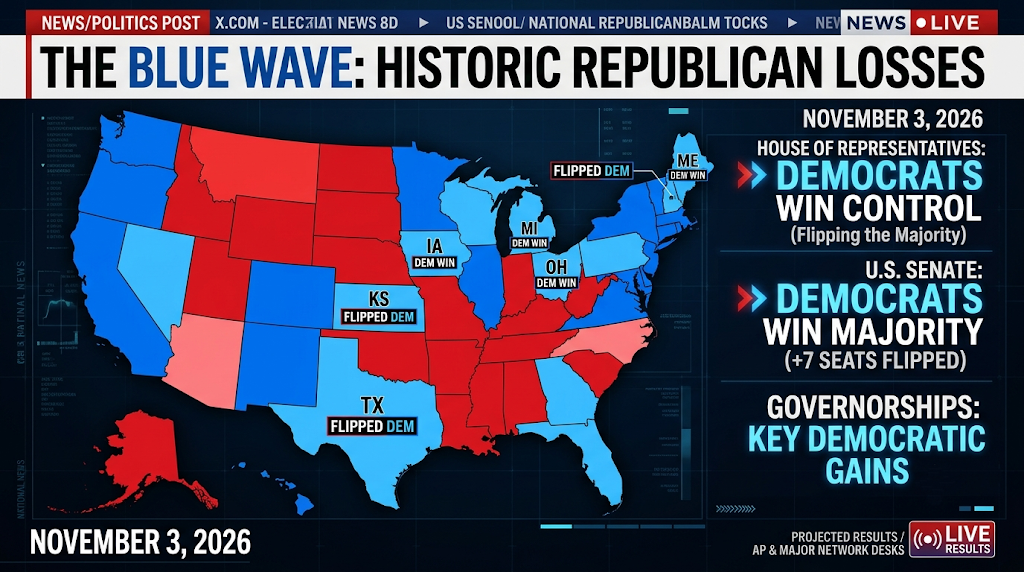
HISTORIC REPUBLICAN LOSSES RESHAPE UNITED STATES CONGRESS
In one of the most consequential midterm elections in modern US history, voters have delivered a sweeping rebuke to the GOP, flipping control of both the House and the Senate to the Democratic Party. A massive national shift, fueled by independents, young voters, and unexpected surges in traditional Republican held territories, dismantled the Republican majorities and altered the balance of power for the final two years of Donald J Trump's presidential term.
Key Takeaways:
- THE HOUSE FLIPS: Democrats have secured the 218+ seats needed to reclaim the majority, handing the gavel back to them and halting the GOP legislative agenda.
- THE SENATE SURGE: A historic +7 seat flip for Democrats, securing the majority and giving them power over future judicial and cabinet appointments.
- STUNNING UPSETS: Places that haven't seen Democratic victories in decades went blue—including Kansas electing its first Democratic senator in nearly a century, Annie Andrews winning in South Carolina, and Texas’s Senate seat flipping to the Democrats for the first time in 38 years.
- A BAD NIGHT FOR TRUMP & THE GOP: Despite the President’s efforts to rally the base, the "blue wave" was undeniable, capturing Governorships and Senate races from Maine to the Midwest. With these projected and declared results, the political landscape seems to have been completely transformed.
Having said that, it is highly improbable that Democrats will be able to stamp their mark on the legislative agenda. Here is what is realistic while Democrats hold majority of the seats in US Congress:
The Filibuster and Legislative Gridlock
Sweeping new laws regarding energy policy or healthcare are highly unlikely. Most legislation requires 60 votes in the Senate to overcome the filibuster, and with the 2028 presidential election approaching, the minority Republican party has little political incentive to hand Democrats bipartisan victories. However, Democrats can utilize the budget reconciliation process (which requires only a simple majority) to pass tax and spending measures, provided they can unify their own caucus.
Nominations and Impeachments
A 60-vote majority is not required to confirm or reject presidential nominees. Because Democrats now control the Senate calendar and hold a simple majority, they have an absolute veto over President Trump’s cabinet appointments, agency heads, and federal judges. Regarding impeachments, the Democratic-controlled House can impeach the President or executive officials with a simple majority, but conviction requires a two-thirds vote in the Senate, making removal functionally impossible without massive Republican defection.
Budgets, War Planning, and Military Conflict
While the President wields broad authority as Commander-in-Chief to deploy forces and initiate short-term military actions, Congress holds the "power of the purse." The President cannot sustain long-term military conflicts, fund new war planning, or distribute foreign aid without congressional appropriations. Domestically, the requirement to pass federal budgets sets the stage for high-stakes negotiations and potential government shutdowns, as the executive branch and Congress must eventually agree to keep the government funded.
The Economy, Tariffs, and Markets
- Interest Rates & Inflation: These remain under the purview of the independent Federal Reserve, not Congress. Gridlock may actually help cool inflation by preventing massive new deficit spending.
- Tariff Policy: The President retains extensive unilateral authority to impose tariffs under existing trade laws (like Section 232 and Section 301). Congress is unlikely to muster the veto-proof two-thirds majorities required to override executive tariff actions.
- AI and Non-AI Stocks: Wall Street historically favors divided government. Gridlock means corporate taxes and major tech regulations are unlikely to change drastically, providing the stability and predictability that equity markets generally prefer.
Executive Power and Congressional Oversight.
Then there is also a shifting balance of power reflected recent legal realities. The Supreme Court's 2024 decision in Trump v. United States significantly expanded presidential immunity and defined certain core executive functions (such as the pardon power and direct control over Justice Department investigations) as strictly off-limits to congressional oversight. While the Democratic Congress will issue subpoenas and launch investigations, the executive branch will aggressively use this recent precedent to resist compliance, meaning many oversight efforts will result in prolonged, difficult court battles.
 Contributors to Wikimedia projects